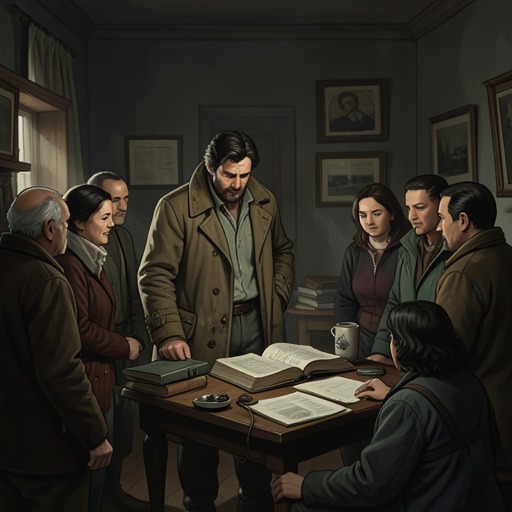
Johane (John Williamson's wife)
Wolf HallJohane (John Williamson's wife) is a member of Thomas Cromwell’s household whose personal history is closely tied to Liz Wykys, her sister and Cromwell’s late wife. As grief draws Johane and Cromwell toward one another, their closeness remains constrained by her existing marriage and by the laws and customs they discuss. Her frankness also gives domestic life a political edge: she recognizes what royal supremacy and the king’s marriage plans would mean for women, for Mary Tudor, and for the future succession.
Identity and Household
Johane is associated with Cromwell’s home and family circle. When Thomas Cranmer visits, she is present with the household while its children race Gregory Cromwell’s greyhounds through the hall. Alice identifies the household’s unruly playfulness and says that Johane is standing by with needle and thread. Johane’s place in this shared domestic world is practical as well as intimate: she belongs among its women, children, and everyday routines, rather than appearing only as a political observer.
Her closest connection within the household is to Liz Wykys. Johane recalls that, when they were young, Liz plaited her hair and tucked it under her hood, and Johane did the same for Liz. Their shared history is evoked through ordinary acts of care and through the contrast between their earlier poverty and the comfort surrounding them now. The relationship helps explain why Johane’s closeness with Cromwell carries the continuing presence of his dead wife.
Grief, Intimacy, and Constraint
Johane tells Cromwell that, for a long time after Liz’s death, she expected Liz to walk in one day. She and Cromwell had been drawn together in the shock and sorrow of bereavement, but Johane recognizes that this cannot remain their only bond: they will continue to be sorry, she says, while also needing to leave behind the behavior born of their first grief. Her words frame their relationship as both an attachment and an attempt to reckon honestly with its origin.
That intimacy is limited by Johane’s marriage to John Williamson. He is still alive and chronically ill; his cough is familiar enough that those around him listen for it, and a physician has advised country air and avoidance of smoke and fumes. Johane acknowledges that she thinks each winter may be his last, but says she could not marry Cromwell immediately after his death: the church and the law would not allow it. Cromwell answers that one never knows, but the conversation offers no resolution. Their possible future remains conditional on circumstances neither controls.
Mercy tells Cromwell that Johane wants to speak with him and that he owes her a hearing. In their conversation, Johane describes her sense that the past can no longer be treated as though Liz might return. She also shows that affection does not erase the difficulty of their position: she can speak openly about desire, bereavement, marriage, and the limits imposed by law without pretending that any of them has been settled.
Memory, Money, and Self-Respect
Johane measures change through objects. She points to a clock, a carved chest brought from Flanders, painted pictures, musical instruments, books, and an ivory comb of her own. In childhood, she had not owned a comb or looked at herself in a mirror; Liz had arranged her hair, while other people told them whether they looked as they ought. The possessions in Cromwell’s household therefore signify more than affluence: they mark a life in which Johane has acquired material comfort and a new ability to see herself as an individual.
Cromwell responds by telling her about the Florentine friar Fra Savonarola and the bonfires in which people destroyed the things they had made or bought, including their mirrors. He makes the mirror the crucial loss: without it, people cannot look at their faces and recognize how they differ from beasts. The story lets him explain why he wants Johane to have a fine glass and to be able to regard herself with dignity. Her attention to what has changed in her life thus prompts a reflection on money as something that can provide not only luxury but also the means of self-recognition.
Johane’s material history is also bound to the poverty she and Liz endured. Cromwell recalls the severity of their earlier lives, including the expectation that a child should not be accustomed to having a shirt warmed by the fire. The contrast gives weight to Johane’s inventory of present comforts: the household’s possessions are evidence of change, but they also keep the hardships of the past in view.
Political Understanding
Johane sees the implications of the king’s campaign to marry Anne Boleyn and reshape the church. She challenges Cromwell about the argument that Henry can marry Anne despite having been with her sister Mary. Cromwell says that scholars consulted in Venice have concluded that the relationship is not incestuous unless a marriage had actually taken place between the king and the sister. Johane asks about the cost of the advice and bluntly observes that it does little to help his case.
Her political analysis becomes still more direct when she describes the consequences she believes will follow if the king breaks the power of the bishops, becomes head of the church, and takes church revenues from the Holy Father. Henry, she predicts, will then be able to declare what is lawful, set aside his wife, marry Anne, and decide what counts as sin. Mary Tudor, in this account, would be treated as illegitimate, and the next king would be whatever child Anne bore. Johane’s response connects religious jurisdiction to marriage and succession, showing that the constitutional dispute reaches into the status of women and the security of the royal line.
Cromwell’s suggestion that she bring this argument to Parliament is partly playful, but it also recognizes its force. Johane says the Commons will not vote for such a course. The exchange places a household conversation beside formal political debate: she identifies the stakes with clarity, even as the institutions making the decisions remain beyond her reach. Her role in the narrative is not to direct policy but to articulate, from within domestic life, the human and dynastic consequences of the changes Cromwell helps advance.